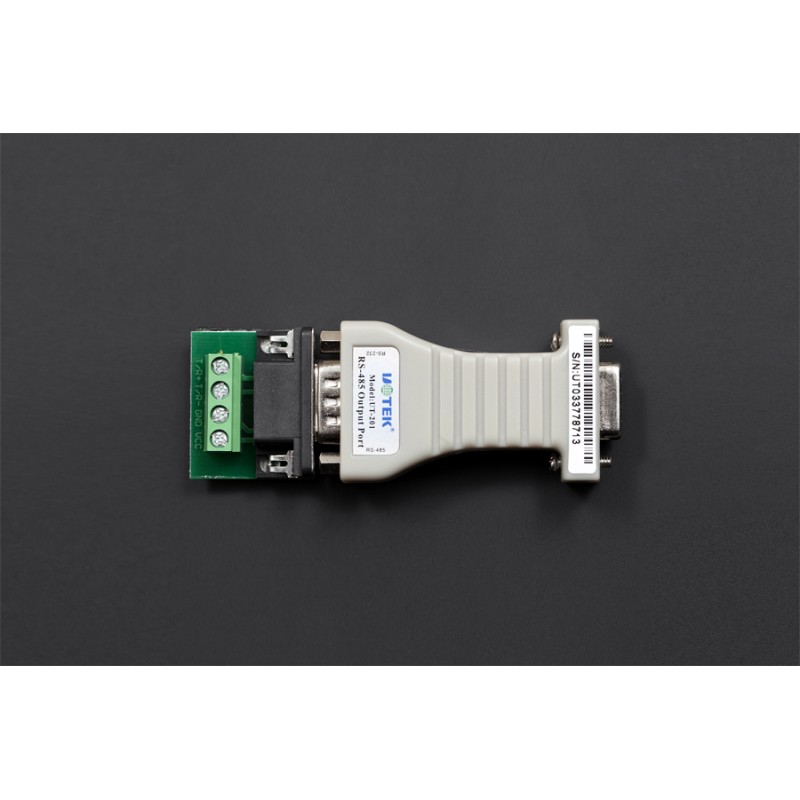
RS-232 to RS-485 Converter

20,62

Converti RS-232 in RS-485 per estendere distanze, collegare più dispositivi e migliorare l’immunità al rumore. Ideale per automazione industriale e reti seriali.

COD: DF-TEL0038 Categorie: ,

Descrizione

RS-232 to RS-485 Converter: Bridge Your Serial Communications

An RS-232 to RS-485 converter is a vital device in industrial and commercial applications, designed to seamlessly bridge communication between systems utilizing the RS-232 and RS-485 serial standards. While RS-232 is a venerable point-to-point communication standard, its limitations in distance, noise immunity, and multi-drop capabilities often necessitate its conversion to the more robust RS-485 standard for modern industrial networks.

What is an RS-232 to RS-485 Converter?

This converter acts as a data translator, converting the single-ended signals of RS-232 into the differential signals of RS-485. Essentially, it allows an RS-232-enabled device (like a PC, PLC, or sensor) to communicate effectively with an RS-485 network, overcoming the inherent restrictions of RS-232.

Key Features and Benefits:

  • Extended Communication Distance: RS-485 can transmit data reliably over distances up to 1200 meters (4000 feet), significantly surpassing RS-232’s typical 15-meter (50-foot) limit. This is crucial for large facilities and remote monitoring.
  • Multi-Drop Network Capability: Unlike the point-to-point nature of RS-232, RS-485 supports multiple devices (up to 32 standard loads, or more with specialized transceivers) on a single bus. This enables cost-effective networking of sensors, actuators, and control systems.
  • Enhanced Noise Immunity: RS-485 utilizes differential signaling, where data is transmitted as the difference between two voltage lines. This makes it highly resistant to common-mode electrical noise and electromagnetic interference (EMI), a critical advantage in noisy industrial environments.
  • Half-Duplex or Full-Duplex Operation: Most converters support half-duplex RS-485 (two-wire), where devices take turns transmitting and receiving, but some also facilitate full-duplex (four-wire) communication for simultaneous data transfer.
  • Automatic Data Direction Sensing: Many modern converters feature auto-direction sensing, eliminating the need for software control of data flow for half-duplex RS-485, simplifying integration.
  • Data Rate Flexibility: These converters typically support a wide range of baud rates, ensuring compatibility with various legacy and modern serial devices.
  • Optical Isolation (Optional): High-end converters may include optical isolation to protect connected devices from ground loops, voltage spikes, and transient surges, enhancing system reliability and safety.
  • Power Options: Converters can be self-powered (drawing power from the RS-232 handshake lines), externally powered via an AC/DC adapter, or powered via USB.

Typical Applications:

RS-232 to RS-485 converters are indispensable in a multitude of sectors, including:

  • Industrial Automation: Connecting PLCs, HMIs, motor drives, and sensors over long distances.
  • Building Management Systems (BMS): Interfacing heating, ventilation, and air conditioning (HVAC) controls, lighting systems, and access control.
  • Security Systems: Connecting surveillance cameras, card readers, and alarm panels.
  • Point-of-Sale (POS) Systems: Extending peripheral connections in retail environments.
  • Remote Data Acquisition: Gathering data from remote instruments and meters.
  • Process Control: Monitoring and controlling industrial processes.

Why Choose an RS-232 to RS-485 Converter?

By converting RS-232 signals to RS-485, you gain the ability to:

  • Extend your serial communication range far beyond RS-232 limits.
  • Create cost-effective multi-drop networks with numerous devices.
  • Ensure robust and reliable data transmission in electrically noisy environments.
  • Future-proof legacy RS-232 equipment by integrating it into modern industrial networks.

Investing in a quality RS-232 to RS-485 converter is a smart choice for enhancing the flexibility, reliability, and reach of your serial communication infrastructure.